A water park budget is not a single number. It is a set of decisions made in a fixed order, and every decision constrains the ones that follow. Owners who understand that order usually land within ten percent of their estimate; owners who start with a ride list usually discover the gap halfway through construction. This article sets out the main costs in the order they should be budgeted.
Start with the water park building cost for your site size, then work backwards through the blocks that make it up. When budgeting for a water park project, the most useful discipline is to separate fixed costs, which do not change with park size, from variable costs, which scale with water area and guest capacity.
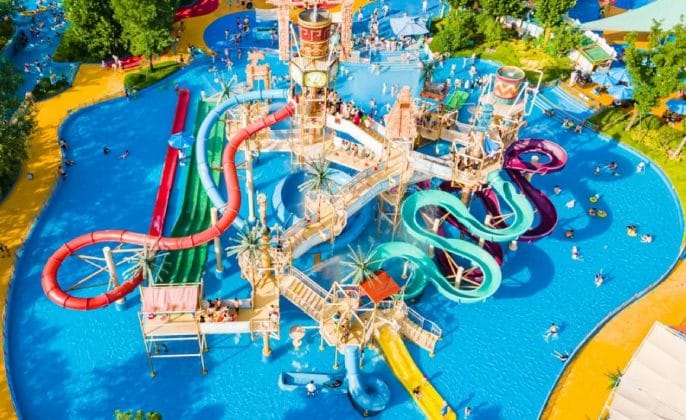
The Main Cost Blocks, In Budgeting Order
| Block | Typical share | Why it comes first |
|---|---|---|
| Site works and earthworks | 8 – 15% | Determines what can be built where |
| Water treatment and plant room | 10 – 18% | Sets pipework, pumps and building volume |
| Pools and waterproofing | 12 – 20% | Defines the water area and deck layout |
| Attractions and slides | 30 – 45% | Chosen last, against the fixed envelope |
| Buildings and guest facilities | 12 – 18% | Driven by legal occupancy and comfort |
| Installation, freight, commissioning | 8 – 14% | Depends on the country and the schedule |
Budgeting in this order prevents the classic mistake of buying attractions first and then discovering that the plant room, the drainage or the access road does not fit the remaining money.
Where Water Park Budgets Usually Break
Water treatment sized for the first phase only
Turnover rates set by local health codes dictate pump size, pipe diameter and the floor area of the filtration building. Sizing for phase one and expanding later is almost always more expensive than sizing once for the finished park.
Attractions chosen before the water area is fixed
Slide towers, splash structures and wave pools all consume deck space, queue space and plant capacity. Choosing them before the pool geometry is settled guarantees redesign.
Materials specified by price alone
Slide shells, play panels and structural coatings decide maintenance cost for a decade. A Polyvinylidene fluoride coating on steelwork or a properly specified gelcoat on a slide shell costs more at purchase and far less over the life of the park than the cheapest alternative.
Capital Budget vs Operating Budget
Most feasibility studies stop at construction and understate the operating budget. Lifeguards, energy, chemicals and planned maintenance are recurring costs that start on day one. A rule of thumb used by operators is to reserve three to five percent of the attraction package each season for pumps, seals, surfaces and controls, on top of staffing and utilities.
When you model the water park development cost, include the first three operating seasons, not just construction. Parks that look profitable on capital alone often fail on the operating line in year two.
How to Keep the Budget Under Control
- Fix the water area and guest capacity before approaching suppliers.
- Get a geotechnical report before design, not after foundations.
- Quote freight, duties and installation as separate lines, not percentages.
- Keep a ten percent contingency that nobody is allowed to spend early.
- Phase the build so the first stage can open and earn.
If you want the block-by-block breakdown behind these percentages, learn more. It walks through each line with indicative ranges by park size.
How to Compare Water Park Quotations
Three quotations for the same park rarely describe the same project. Before comparing totals, put the following on one line each and check that every supplier is answering the same question.
- Scope of supply. Are slides, splash structures, filtration and the plant room all included, or is the plant room a separate contract?
- Civil works. Who designs the pool shells and foundations, and who carries the risk if the ground conditions differ from the survey?
- Installation. Is supervision included, and for how many days? Who supplies cranes, scaffolding and local labour?
- Commissioning and training. Is there a documented handover with operator training, or does the park need to arrange it separately?
- After-sales. What is the spare parts response time, and what does the warranty actually exclude?
A quotation that looks ten percent cheaper usually differs on one of these five lines. Normalising them before signing is the single most effective way to protect the budget you have just built.
Frequently Asked Questions
What percentage of a water park budget is equipment?
Attractions and slide equipment usually account for 30 to 45 percent of total capital cost, with water treatment and civil works taking most of the rest.
Should I budget for a wave pool from the start?
Budget the plant room for it from the start even if the wave pool comes in phase two. Retrofitting filtration and pipework costs far more than sizing them once.
How much contingency is realistic?
Ten percent on top of a well-defined scope, and more if the site has not been surveyed or the ground conditions are unknown.
Next Step
Send us your site area and target opening date, and we will turn this structure into a costed estimate using water park equipment from Dinis, with attractions and the plant room quoted together. As a turnkey water park supplier, we can also advise on phasing so the first stage opens within budget and earns while the second stage is built.
Leave a Reply