For a small amusement park, the question is not whether a carousel is beautiful – it is whether the ride earns its place. A carousel occupies prime central space, consumes capital, and needs staff every hour the park is open. So the investment has to be tested against throughput, ticket price and the way families actually move through the park.
This article builds that test for a small park considering whether to buy an amusement park luxury carousel.
The Short Answer
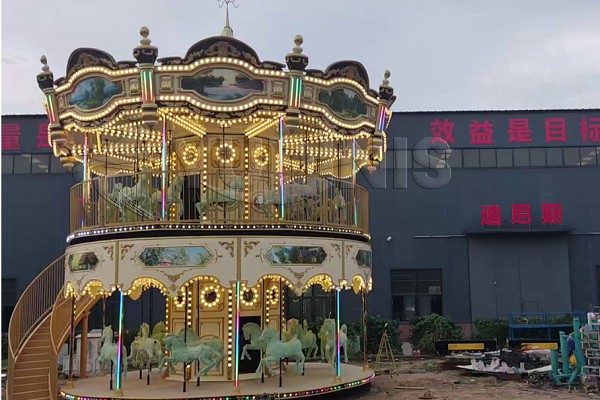
For most small parks with family traffic, a carousel is one of the safest investments available. It appeals across ages, runs all day, needs little maintenance compared with a coaster, and acts as a visual centrepiece. The exceptions are parks with no family audience, sites too tight for a compliant layout, or operators who price the ride too low to recover the capital.
What Drives the Return
Throughput
A 24-seat carousel cycling every three minutes carries roughly 300 to 380 riders per hour. A 36-seat unit can exceed 500. That throughput is available every operating hour, unlike a headline coaster that empties between cycles.
Dwell time and secondary spend
Families that stop for the carousel usually buy something else – a drink, a snack, a photograph. The ride’s direct ticket revenue is only part of its contribution; the rest appears in food and beverage and retail.
Photographic value
A well-themed carousel is photographed constantly. Those photographs become free marketing, and they are the reason theming pays for itself on a ride that is otherwise mechanically similar to every other carousel.
A Simple Payback Model
| Input | Example |
|---|---|
| Installed cost | USD 250,000 |
| Riders per day (average) | 600 |
| Ticket per ride | USD 3 |
| Daily ticket revenue | USD 1,800 |
| Operating days per year | 300 |
| Gross annual revenue | USD 540,000 |
| Operating cost (staff, power, maintenance) at 55% | USD 297,000 |
| Contribution before tax | USD 243,000 |
On those assumptions the ride pays back in about one season. Real parks rarely achieve that, because the average rider count is lower and operating costs are higher. But the model shows the two numbers that matter: riders per day and the share of revenue consumed by operating cost.
Choosing the Right Size
A 16-seat unit suits malls and hotel gardens. A 24-seat unit is the usual sweet spot for a small park, balancing capacity against the space required for a 24 seat carousel and the foundation cost. A 36-seat unit only makes sense where weekends regularly produce long queues.
If the park is outdoors and exposed to sun, wind and rain, specify the weather-resistant carousel for outdoor parks from the start: canopy materials, corrosion protection and drainage all affect how the ride looks after three seasons.
Where Small Parks Go Wrong
- Oversizing. Buying the largest carousel the site will hold, then running it half empty.
- Underpricing. Treating the ride as a free amenity instead of a revenue line.
- Ignoring the queue. A ride that loads slowly loses the throughput the payback model assumed.
- Skipping maintenance. Paint, lighting and bearings degrade faster outdoors than owners expect.
- No theming. A plain carousel in a plain plaza does not generate photographs.
Operating Costs to Budget
Staffing is the largest recurring cost. A carousel needs at least one operator and, at peak, a second person at the entrance. Power consumption is modest but continuous. Maintenance includes lighting, bearings, carriage hardware and periodic refinishing of FRP or fibreglass components. Set aside three to five percent of the ride value each year for planned maintenance.
When It Is Not Worth It
A carousel is a poor fit for a park with no family audience, for a site where the safety zone would block a main path, or for an operator who cannot staff it consistently. In those cases a smaller flat ride or a family coaster may serve the audience better.
How the Carousel Compares with Other Family Rides
A teacup ride may be cheaper, but it carries fewer guests and appeals to a narrower age band. A family coaster delivers more thrill but costs several times as much and needs a larger safety envelope. A carousel sits between them: modest capital, high capacity, and a guest mix that includes grandparents, parents and small children together.
That last point is easy to underestimate. The carousel is one of the few rides a whole family can share at the same time, which is why it appears in almost every family park regardless of size. When you compare payback, compare it against the cost of serving that whole-family segment some other way – often there is no cheaper alternative.
Frequently Asked Questions
How long does a carousel last?
With proper maintenance, 15 to 20 years is realistic. Fibreglass horses and carriages may need refinishing every few years in strong sun.
Is a 36-seat carousel too big for a small park?
Only if your peak attendance cannot fill it. Capacity that sits idle is capital that never earns.
What is the biggest hidden cost?
Staffing and the foundation. Both are usually higher than first-time buyers expect.
Next Step
Send us your park size, expected daily attendance and target ticket price, and we will model the payback with a configuration that fits. Our Dinis amusement equipment can supply a 16, 24 or 36-seat unit with the theming and weather protection your site needs, and as an outdoor amusement ride manufacturer we can advise on layout and operating costs. For full specifications, see the full specification.
Leave a Reply